High Street
Oxford, OX1 4BG


The Humble Boot Scraper
A link to the lived past in our towns and cities ...
Introduction to Boot Scrapers
Boot scrapers, foot scrapers, mud scrapers, no matter what they are called, they are familiar, dependable, characterful, sometimes fragile, architectural accessories to remove filth from the bottom of your shoe or boot. Prevalent in the 18th and 19th centuries across the UK, Europe and the U.S.A, they were placed outside the doorway of buildings.
Each boot scraper is worthy of being recorded, providing a link to the people, culture, the buildings and streets where they are found. Read more about boot scrapers by clicking here.
In my search for boot scrapers, I have walked along streets that have hardly changed since the 18th and 19th century. These streets are often the oldest areas of our towns and cities giving us a glimpse of life lived, a feel of the past. There is history and stories attached to most of these streets: about the architecture or the people who lived in the buildings, sometimes, tales about the boot scrapers.

You can also go on a Heritage Trail.
Our first city is Oxford. Click here to embark on the trail!


Are you interested in taking photographs and gathering information about boot scrapers around your city?
Are you passionate about Boot Scrapers and want to know more?
For a more detailed introduction, go here.
Click to get involved.
An anecdote about Charles Dickens' first London Home
In the book “Dickens and the Workhouse” historian Dr Ruth Richardson mentions when visiting one of Charles Dickens’ first London homes in the last decade, she made a small but wonderful discovery. She went along to the house in central London with an inventory that she found in a London archive of fixtures and fittings which were in the house in the C19th including – fireplace, 11ft shelves, doorway with Edwardian glass. The last line reads:
“...a fireplace, tall cupboards and window shutters, all now disappeared, as has the brass door knocker listed in the Schedule. But the little foot-scraper listed outside still stands.”[4]

Charles Dickens first London home 22 Cleveland Street, London W1. Charles Dickens lived here between 1815-1816 as a child and later in 1828-1831 as a teenager.(5) Image taken 19th August 2017

The little cast iron foot scraper outside Charles Dickens first London home still stands. (left hand side of the doorway) Image taken 19th August 2017


Advertisement for ZEBO Reckitt & Sons Ltd, Hull & London
Makers of Zebo Grte Polish in packets, or as a paste in tins.
Do yourself a good turn. Make the scraper bright and black with Zebo, then he will not forget to scrape his boots before he comes in. Not only will the scraper, and any other outdoor ironwork look belter, but the ironwork will benefit by being polished with Zebo Liquid Grate Polish….
Portsmouth Evening News – Friday 27th April 1923
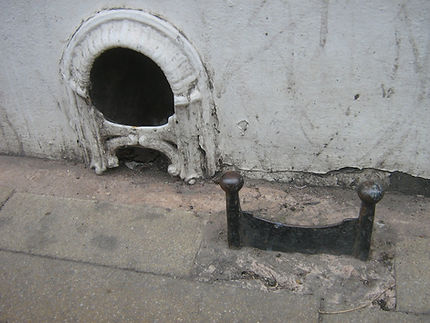
An example of finding two boot scrapers together at 24 The Tything, Worcester. One boot scraper within the recess of the building and a scraper within the paved area outside this Georgian building.
Image taken 21st May 2011.
Strand Union Workhouse, Cleveland Street, London W1. Dr Ruth Richardson suggested that this building probably inspired Charles Dickens to write 'Oliver Twist'. Image taken 19th August 2017

Rag and Bone collector was sent to prison with stealing an iron boot scraper January 10th. The ownership of the scraper was unknown at the previous hearing, but it was now stated that it belonged Mr John Brown. Hazleview, Clarendon-road.
The evidence Det.-Sergt. Marsh was read over and confirmed. He told the prisoner he would be charged with stealing the scraper, the property of Mr Brown. Prisoner said, "You never saw me steal it, I bought it off a little boy for one penny".
Published: Friday 24 January 1913
Newspaper: Cambridge Independent Press
County: Cambridgeshire, England